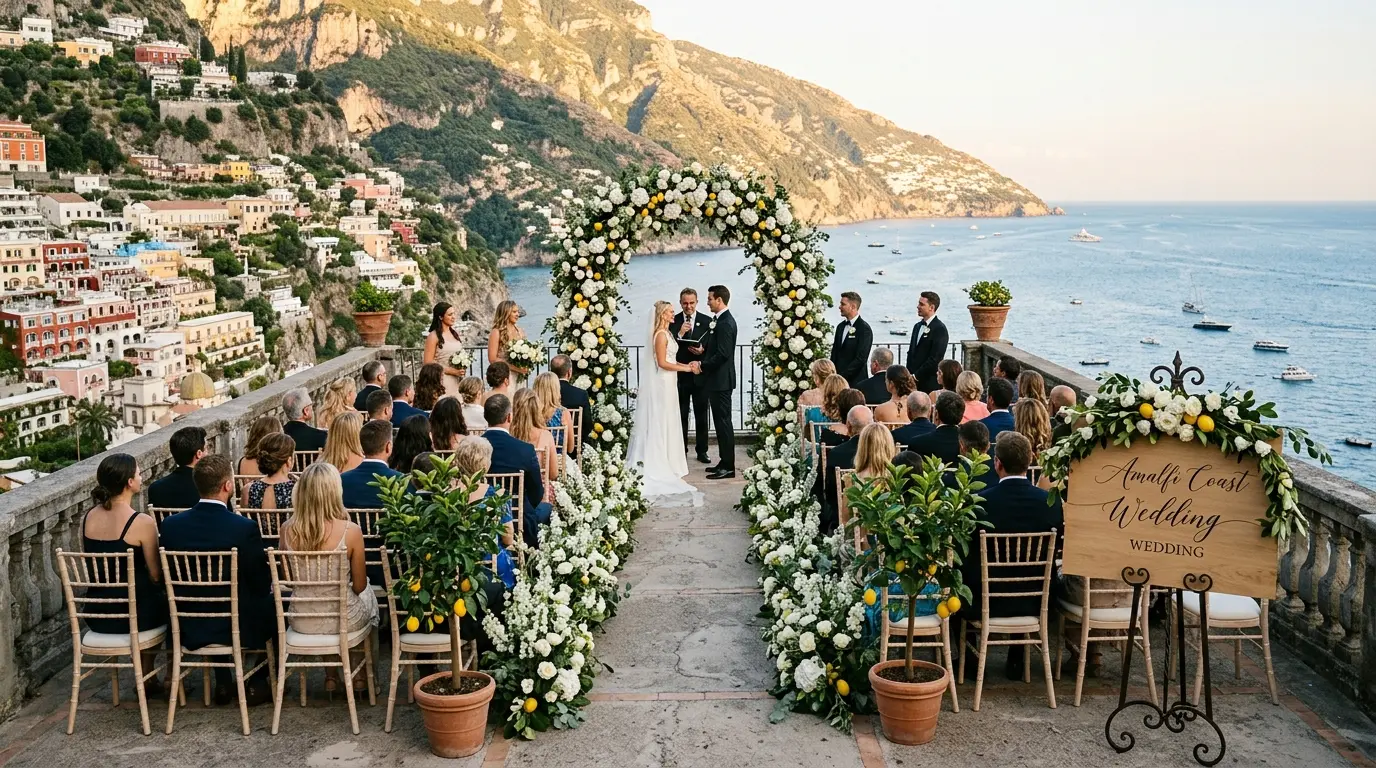
Most guides show you pretty venues and stop there. The things that shape your day are less glamorous: paperwork, one narrow road, and a lot of stairs.
This guide starts with those decisions, because they change which venue makes sense.
An Amalfi Coast wedding works best when you pick your legal route first, book your date well ahead, and choose the town by guest count and access rather than views alone. Most international couples marry legally at home and hold a symbolic ceremony on the coast. A legal civil ceremony in Italy is possible but typically needs three to four months of preparation.
Decide the Legal Route Before You Tour a Single Venue
The legal route controls where you can hold the ceremony. A terrace with a perfect view may be off the table if you want the marriage to be legal in Italy.
| Route | Legally binding | Paperwork | Where it can happen |
|---|---|---|---|
| Symbolic in Italy, legal at home | Legal at home only | None for Italy | Any terrace, garden or villa |
| Civil in Italy | Yes | Consulate document, apostilled papers, translations, town hall filing | Town hall or approved venue |
| Catholic in Italy | Yes | Civil papers plus church documents and marriage preparation | A church only |
Catholic ceremonies must take place in a church, and at least one partner must be Catholic. If you're picturing vows on a cliffside terrace, that rules this route out.
For most couples the symbolic route is the practical one. You sign at a registry office at home, then hold the ceremony you actually want on the coast.
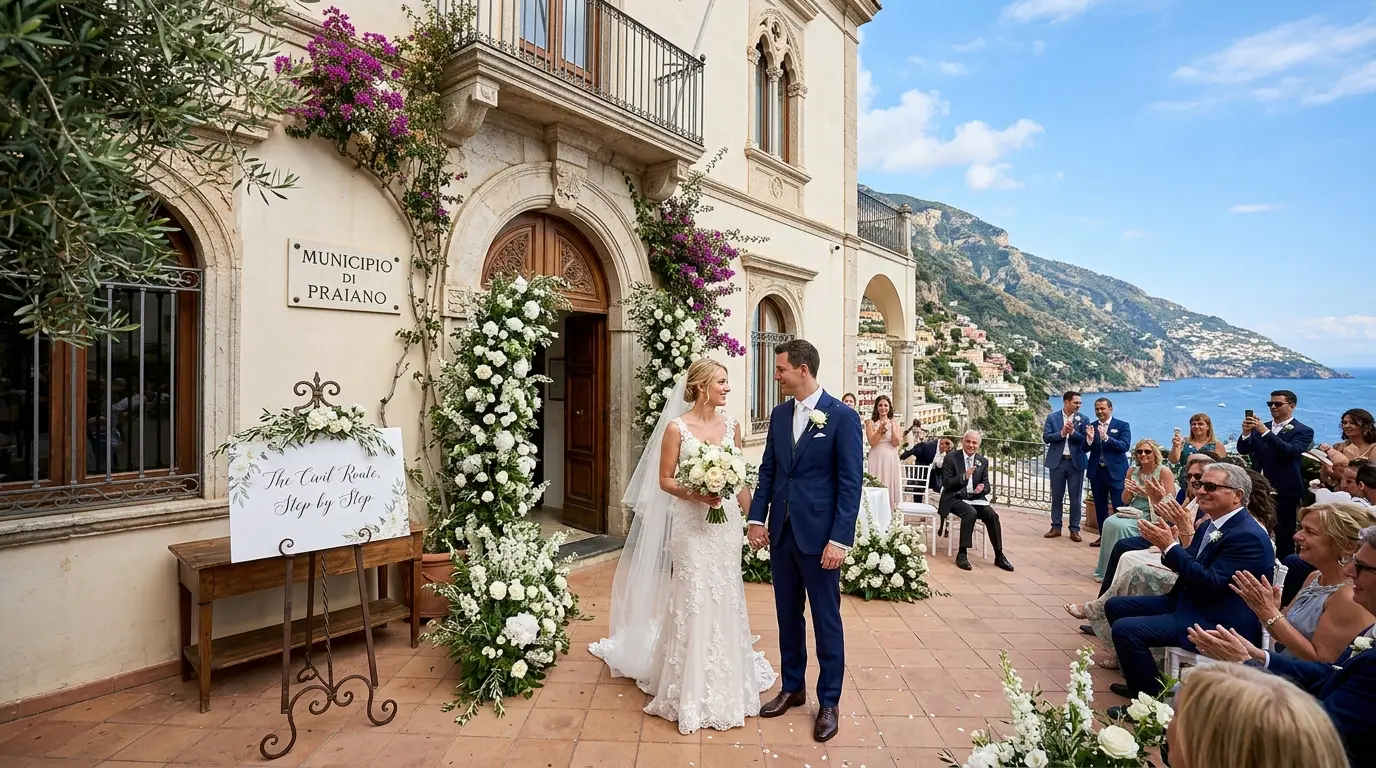
The Civil Route, Step by Step

Some couples want the certificate to say "married in Italy." That's manageable if you start early.
You may read that foreigners must live in Italy for 30 days first. Current guidance says foreigners can marry legally in Italy without residency.
What you do need depends on your nationality:
- Order full birth certificates. Italy wants the full version showing parents' details, not a short extract, and ordering the wrong one costs weeks.
- Get your "free to marry" document. US citizens sign an affidavit at the US Embassy or a consulate in Italy, and it is then legalized at the local Prefettura if the wedding is outside that city. Other nationalities follow different routes, so check yours.
- Translate and legalize. Documents need sworn Italian translations and, usually, an apostille.
- Book the consulate early. Some consulates have appointment waits of around eight weeks in peak season.
- Arrive a few days ahead. Most couples arrive two to seven working days before the ceremony to finish the legal steps.
- Bring two witnesses and expect Italian. The ceremony is conducted in Italian, so you'll need an approved interpreter if neither of you speaks it.
- Budget for it. One estimate puts paperwork at roughly €600 to €2,000, with town hall fees higher in tourist destinations.
Pick the Town by Guest Count and Access
Here is how I'd match group size to setup. The venue names are examples, not endorsements.
| Guest count | Good fit | Watch out for |
|---|---|---|
| 2 to 15 | Public viewpoints or a hotel terrace in Positano, Amalfi or Ravello | Permits and crowds; sunrise avoids both |
| 16 to 60 | Boutique cliff hotels such as Villa Treville or Villa San Giacomo | Stairs, tight parking, few rooms for guests |
| 60 to 120 | Palazzo Avino, Hotel Santa Caterina, Villa Cimbrone | Renting the whole site and hotel room blocks |
| 120 to 200 | Caruso in Ravello, Villa Eva, Villa Astor near Sorrento | Shuttle logistics and early booking |
Treat every published capacity as a starting point. Published listings put Caruso's capacity anywhere from about 170 to 200 guests, and Villa Treville's capacity varies between 77 and 80 across different sources. Layout, seated dinner versus standing reception, and whether you're renting the whole property all change the number.
Ask for a written capacity for your exact format.
What to Ask a Venue That the Brochure Won't Tell You
Photos show views. These questions show whether the day will work:
- Is anyone else staying on site? Some venues, such as Villa Eva, have no hotel guests on the property, which gives couples more freedom with music and dancing. At a working hotel, other guests may set your quiet hours.
- Can the venue host a civil ceremony? Some venues hold a civil ceremony licence, Villa Eva in Ravello being one example, while many can only host symbolic ceremonies.
- What is the rental fee, and what does it exclude? Published figures put private-site rental at about €1,500 to €3,000 for Villa Cimbrone, and catering usually comes from the venue's own list or in-house team.
- How early must you book? Villa Cimbrone and Villa Rufolo often need four to six months' notice for ceremony access in peak months, and luxury villas in general often book out a year ahead. Plan for the longer window.
- Where is the rain plan? A covered indoor room should be named in the contract, not promised verbally.
Getting Everyone There: The SS163 Problem
Almost every town on the coast hangs off one road, the SS163. That single fact shapes your guest experience more than any centerpiece.
- Plate alternation. The SS163 uses an odd/even plate rule between 10:00 and 18:00 in listed periods, and fines start around €87. The exact dates are usually announced in May or June. This mostly hits guests who rent cars, so tell them to skip the rental.
- Boats have a season. Ferries between the coastal towns and Capri run from April to October only. A November wedding can't count on them.
- Airport transfers cost real money. Naples airport is about 60 to 90 minutes away, and a private transfer runs roughly €100 to €150 each way. For 40 guests, that adds up.
Here is a scenario I'd flag to any couple. You plan a 4 p.m. ceremony in Ravello and put guests in Positano. The bus back after dinner is the problem, not the ride out. Book the return shuttles first, and have the last departure well after the last dance.
Choose Your Month With Your Priorities in Mind
- Late April to June: Milder temperatures, fresh blooms and fewer tourists. This is the busiest wedding window, so book early.
- September to early October: Warm water, softer light and a calmer pace.
- July and August: Crowds, heat and higher prices. Choose these only if you want a lively coast.
- Winter: Peaceful and quiet, but many venues close. Combined with the ferry season, options narrow quickly.
If crowds worry you, consider a sunrise ceremony. Early ceremonies tend to mean better light and far fewer tourists.
Where the Money Actually Goes
The headline venue fee is rarely the biggest surprise. These add up quietly:
- Planning and local vendors. Symbolic-ceremony packages can start around €970, but on-the-ground services are billed separately by local providers. Read what "from" price includes.
- Guest lodging. A Positano luxury hotel can run €600 to €1,200 a night, while Praiano, Maiori or Minori can be €100 to €200. Housing guests in a nearby village and shuttling them in can cut costs sharply.
- Transport. Transfers, shuttles and boat hires often equal a decent catering line.
- Paperwork, if you go civil.
A 12-Month Plan
- 12 to 9 months out: Choose the legal route, lock the venue and date, and start a guest block for hotels.
- 8 to 6 months out: Hire your photographer and planner, and book shuttles.
- 5 to 4 months out: Order documents and translations for a civil ceremony. Book the consulate.
- 3 months out: Confirm the rain plan, music cut-off and vendor access in writing.
- Final month: Send guests a simple transport guide with shoes, stairs and shuttle times.
Local Touches That Don't Feel Like a Theme Party
Skip the cliché props. Vietri sul Mare is known for its majolica ceramics, which makes hand-painted tiles a genuine, portable favor. A welcome dinner in a smaller village also gives guests something the big towns can't.
Frequently Asked Questions
Can we marry on a beach in Positano?
A legal ceremony needs a licensed beach, and only beaches holding a civil-wedding licence qualify, which are rare. A symbolic ceremony is much easier. Public locations generally work without permits for groups up to 15, with larger groups needing coordination.
Is it manageable for older or less mobile guests?
Yes, if you choose with access in mind. Sorrento has wider streets and easier logistics than Positano. Villa San Giacomo has a private lift from the road below. Tell every guest to pack comfortable flat shoes.
Can same-sex couples marry on the Amalfi Coast?
Italy doesn't recognize same-sex marriage, but civil unions are available. Many couples marry legally at home and celebrate here with a symbolic ceremony. Same-sex micro weddings have been organized in Amalfi.
Can we hold the ceremony on Capri?
Yes, though it adds cost and timing pressure. Expect roughly €200 to €400 added to package prices for vendor travel, and the ferry season applies.
How many nights should guests stay?
Most couples stay two to three nights. For guests traveling from far away, three is safer once you count transfer time and recovery from the drive.
What if it rains?
Ask for a named indoor space in your contract. Showers on the coast are usually brief, and often worth a short wait.
Can we bring our own caterer or vendors?
It depends on the venue. Venues typically have preferred caterers or in-house options. Ask about outside-vendor fees before you sign.
How late can music play?
Town ordinances and noise restrictions can shape your timeline. Get the cut-off in writing and plan the dance floor around it.

Alliance Editorial Team
Our in-house team of wedding writers and editors.