Crystals fascinate people for two different reasons. Geologists study them for their atomic structure and chemistry. Many collectors and practitioners also value them for their symbolism and traditional meanings. This guide covers both, and it keeps them clearly separate.
Mineral facts such as composition, hardness, and crystal system are scientific. Meanings, chakra links, and healing ideas are cultural traditions, not proven medical effects.
What Is the Best Crystal List for Beginners?
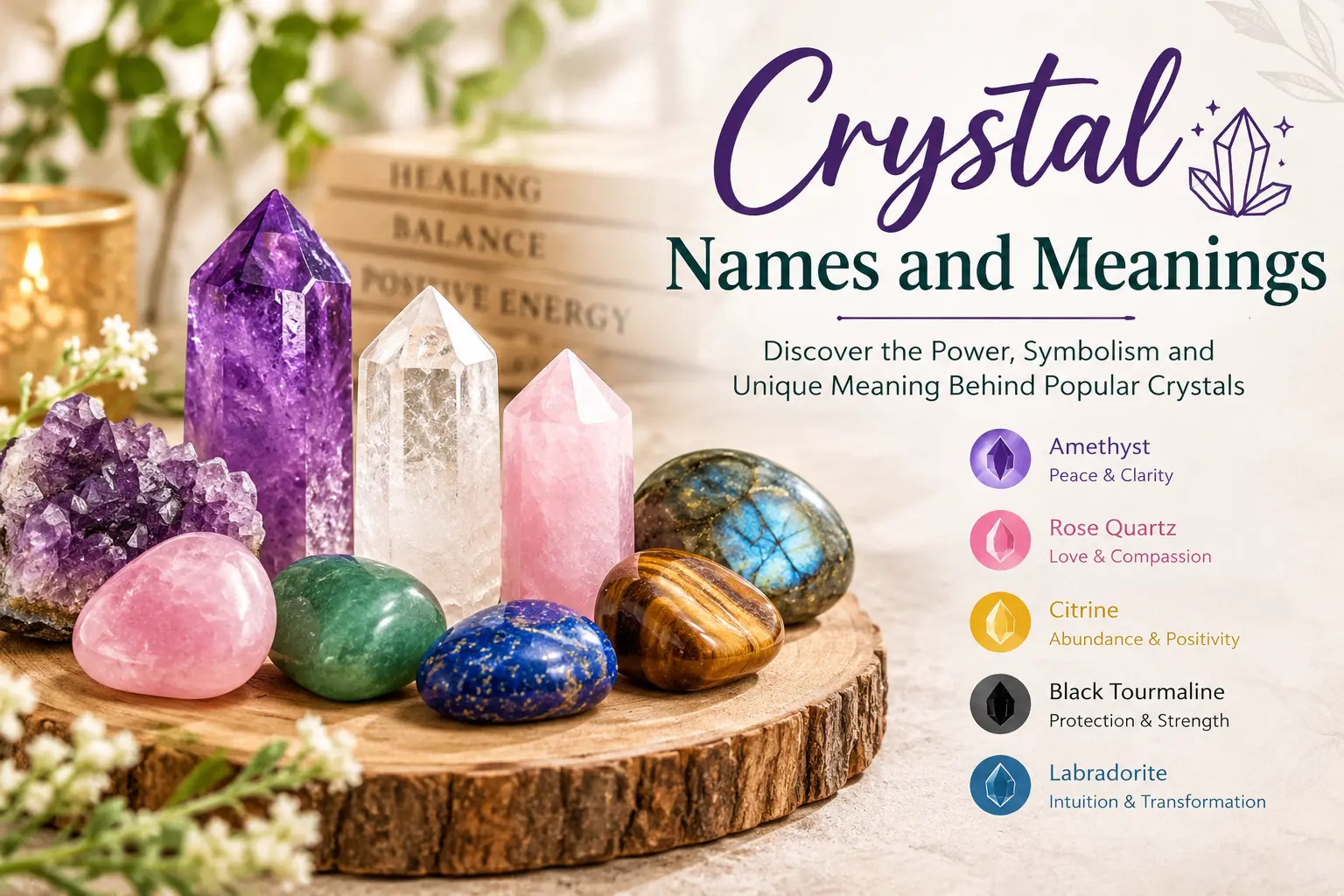
The best starter crystal list is clear quartz, amethyst, rose quartz, citrine, black tourmaline, and selenite. They are widely available, affordable, and easy to identify, and they teach the basics of mineral families and hardness.
| Crystal | Mineral / Composition | Typical Color | Mohs Hardness | Traditional Meaning | Safe in Water? |
|---|---|---|---|---|---|
| Clear Quartz | Silicon dioxide | Colorless | 7 | Clarity, amplification | Yes |
| Amethyst | Quartz (iron + natural irradiation) | Purple | 7 | Calm, intuition | Yes (avoid long sun exposure, it can fade) |
| Rose Quartz | Quartz with trace dumortierite or Ti/Mn | Pink | 7 | Love, self-compassion | Yes (can fade in sun) |
| Citrine | Quartz (iron) | Yellow to orange | 7 | Abundance, confidence | Yes |
| Black Tourmaline (Schorl) | Sodium iron aluminum borosilicate | Black | 7–7.5 | Protection, grounding | Yes |
| Selenite | Gypsum (hydrated calcium sulfate) | White, translucent | 2 | Cleansing, calm | No |
Good to know: Natural citrine is fairly rare. Much of the citrine sold commercially is heat-treated amethyst or smoky quartz.
What Counts as a Crystal? Mineral vs. Rock vs. Glass
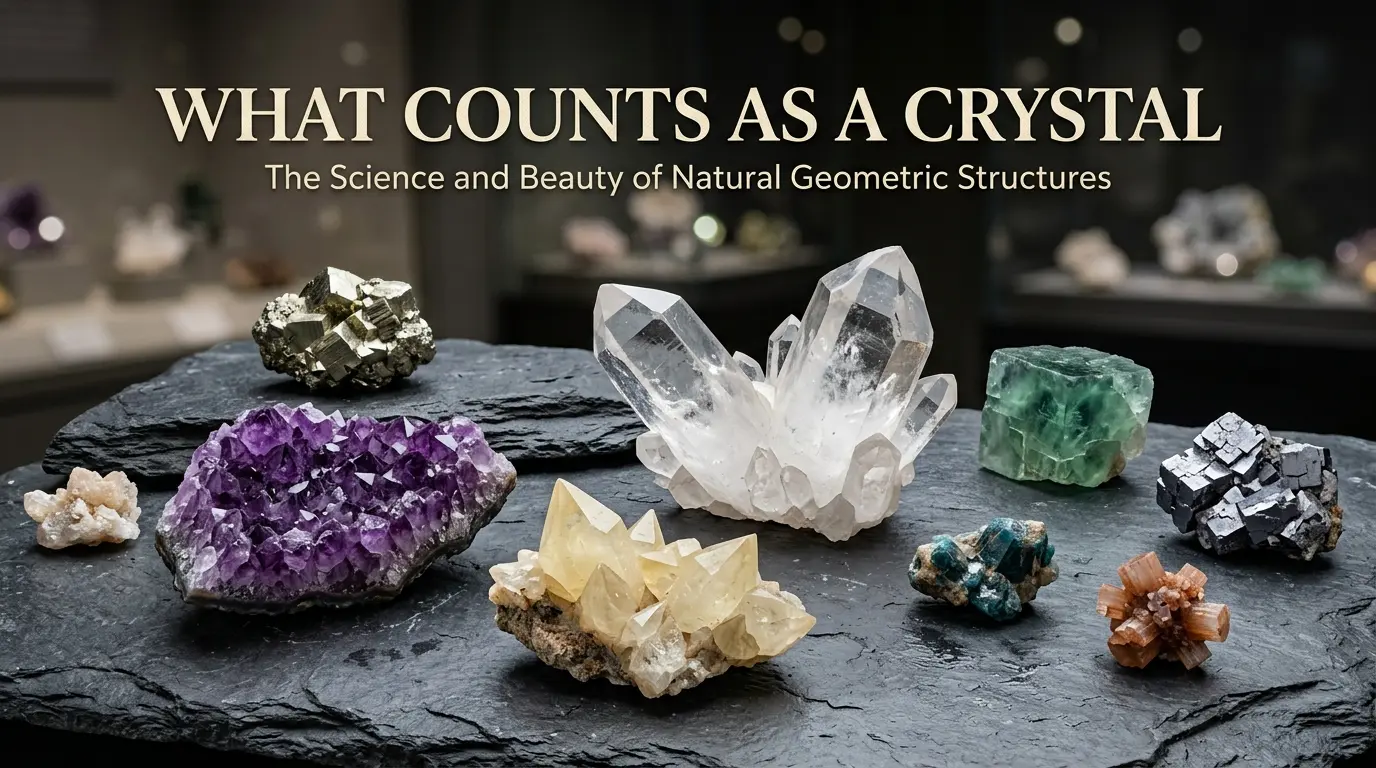
Not everything sold as a “crystal” is one.
- Mineral crystal: a natural solid with an ordered atomic structure, such as quartz or fluorite.
- Rock: a mix of minerals. Lapis lazuli is a rock made of lazurite, calcite, and pyrite.
- Non-crystalline material: natural glass has no ordered structure. Moldavite and obsidian are examples.
Crystal List by Color
Color in minerals comes from trace elements or structural defects, such as iron in amethyst or chromium in emerald. Linking colors to chakras is a tradition from Indian and modern New Age practice. It is not a mineralogical classification.
White, Clear, and Translucent Crystals
- Moonstone (feldspar): Shows a soft blue-white glow called adularescence, caused by light scattering between thin layers of orthoclase and albite. Traditionally linked to intuition and cycles. Mohs 6–6.5.
- Howlite: A calcium borosilicate with gray veining, traditionally used for calm. It is soft (3.5) and often dyed blue to imitate turquoise.
Blue and Violet Crystals
- Lapis Lazuli: A deep blue rock with golden pyrite flecks. Mohs 5–5.5.
- Sodalite: Blue with white calcite veins and no pyrite. Mohs 5.5–6.
- Aquamarine: A beryl colored by iron. Mohs 7.5–8. Traditionally linked to calm and communication.
- Celestite: Strontium sulfate in pale blue clusters. Soft (3–3.5) and fragile.
- Lepidolite: A lilac lithium-bearing mica. Mohs 2.5–3.5. It is often associated with calm and emotional balance in tradition. This is not a medical treatment, and holding the stone does not deliver lithium to the body.
- Fluorite: Calcium fluoride, which forms cubic and octahedral crystals and often shows color zoning in purple, green, and blue. Mohs 4. The word fluorescence comes from this mineral, because many specimens glow under UV light.
Green and Pink Crystals
- Green Aventurine: Quartz with tiny fuchsite (chromium mica) flakes. Mohs 6.5–7. Traditionally linked to luck and prosperity.
- Jade: Two different minerals, nephrite (6–6.5) and jadeite (6.5–7). Known for exceptional toughness and used in carving for thousands of years.
- Malachite: Copper carbonate hydroxide with banded green patterns. Mohs 3.5–4. See the safety section below.
- Rhodochrosite: Manganese carbonate with pink and white bands. Mohs 3.5–4. Traditionally linked to emotional healing.
Yellow, Gold, and Brown Crystals
- Tiger’s Eye: A pseudomorph where silica replaced crocidolite fibers. These fibers create a silky shimmer (chatoyancy). Mohs 7.
- Pyrite: Iron sulfide with a brassy metallic look (“fool’s gold”). Mohs 6–6.5. It can react with moisture over time.
How to Identify Crystals
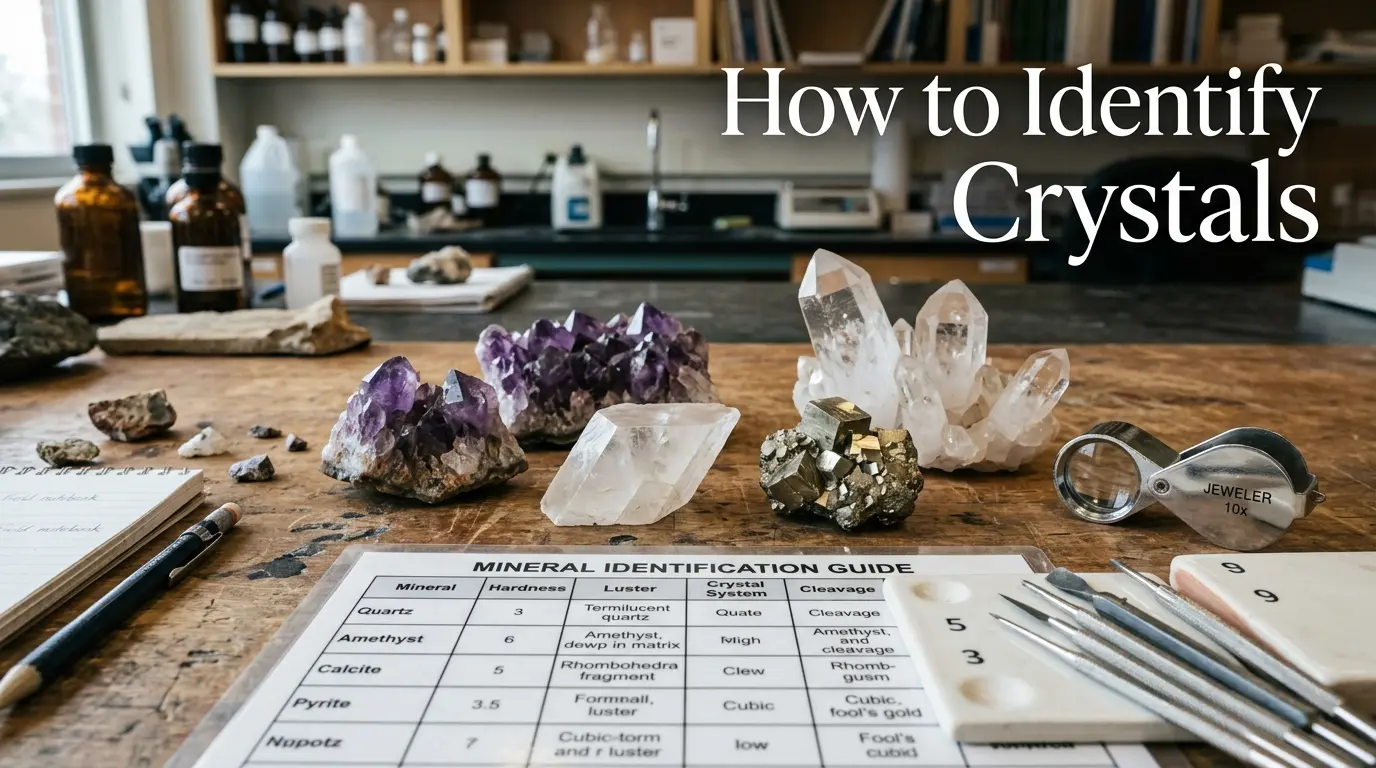
Color alone is unreliable. Use several tests together:
- Mohs hardness: Test what scratches what. Quartz (7) scratches glass, while selenite (2) can be scratched by a fingernail.
- Luster: Is it glassy, metallic, pearly, or silky?
- Streak: Rub the mineral on unglazed porcelain. The color of the powder is a clue. Pyrite leaves a greenish-black streak.
- Cleavage and fracture: Does it split along flat planes (fluorite, calcite) or break in curved shells (quartz)?
- Crystal habit: Look at the shape, such as hexagonal prisms or cubes.
- Weight (specific gravity): Dense minerals feel heavier than they look.
Common Crystal Lookalikes
- Lapis vs. sodalite: Pyrite flecks suggest lapis, and white veins suggest sodalite.
- Citrine vs. heated amethyst: Natural citrine is usually pale and uneven in color, while heated amethyst is often deeper orange with a distinct banded look.
- Howlite vs. turquoise: Dyed howlite is common, and the dye can pool in cracks.
The Seven Crystal Systems
A crystal’s outer shape reflects its internal atomic lattice. All crystals fall into seven systems.
| System | Axes and Angles | Examples |
|---|---|---|
| Cubic (Isometric) | 3 equal axes at 90° | Pyrite, fluorite, garnet, diamond |
| Tetragonal | 3 axes at 90°, 2 equal | Zircon, apophyllite |
| Hexagonal | 3 equal axes at 120° plus 1 vertical | Beryl (emerald, aquamarine), apatite |
| Trigonal | Related to hexagonal, with 3-fold symmetry | Quartz, amethyst, calcite, tourmaline |
| Orthorhombic | 3 unequal axes at 90° | Topaz, peridot, celestite, aragonite |
| Monoclinic | 3 unequal axes, 1 oblique angle | Selenite, malachite, jadeite, kunzite |
| Triclinic | 3 unequal axes, no 90° angles | Labradorite, amazonite, turquoise, rhodonite |
Rare and Collector Crystals
- Alexandrite: A chrysoberyl (Mohs 8.5) that shifts from bluish-green in daylight to purplish-red under incandescent light, due to chromium. Fine natural stones are extremely valuable.
- Larimar: Blue pectolite, with copper giving the sea-blue color. It is found only in the Dominican Republic. Mohs 4.5–5.
- Moldavite: Green natural glass formed about 15 million years ago when a meteorite struck the Ries area in southern Germany. It is mostly found in the Czech Republic. Mohs about 5.5. Fakes are common, so buy from reputable sellers.
- Tanzanite: Blue-violet zoisite, found only near Mount Kilimanjaro in Tanzania. Mohs 6.5–7.
- Painite: Once among the rarest minerals known, first found in Myanmar.
- Grandidierite: A rare bluish-green mineral, mainly from Madagascar.
Crystal Safety: Water, Toxicity, and Handling
Hardness does not decide water safety. Chemistry does.
Crystals to Keep Away from Water
Selenite (slightly soluble and softens), halite (dissolves), and angelite or anhydrite (can convert to gypsum). Pyrite can degrade or release sulfur compounds when damp.
Toxic Minerals
Malachite and chrysocolla contain copper. Galena contains lead, realgar contains arsenic, and cinnabar contains mercury. Do not use them in drinking water, and wash your hands after handling raw specimens.
The Indirect Method
If you want crystals near your water, keep them in a sealed, separate container. Or skip the infusion idea altogether, since it adds no proven benefit.
Dust and Sun Fading
- Dust: Cutting or polishing stones like malachite creates hazardous dust. Wear a respirator and work wet.
- Sun fading: Amethyst, rose quartz, and fluorite can fade with long sun exposure.
Frequently Asked Questions
How many crystals are there?
There are thousands of known minerals, and only a fraction are commonly sold as crystals. Collectors usually focus on a few dozen.
Do crystals have healing powers?
There is no scientific evidence that crystals treat medical or mental health conditions. Many people enjoy them for their beauty, meditation, or symbolic value. For health concerns, consult a qualified professional.
Which crystals should never go in water?
Selenite, halite, angelite, pyrite, and any toxic mineral such as malachite or galena.
How can I tell if a crystal is real?
Check hardness, weight, and internal features such as bubbles in glass. Buy from sellers who disclose treatments and origin. When unsure, a local gem lab can confirm.
What is the difference between a crystal and a gemstone?
A crystal refers to a mineral’s natural structure. A gemstone is a mineral (or sometimes organic material) valued for jewelry because of its beauty, durability, and rarity.
Conclusion
Learning crystals starts with the fundamentals: composition, hardness, and crystal system. Once you can identify a stone, the traditional meanings become a cultural layer you can explore, as long as you stay safe and honest about what a crystal can and cannot do.

Alliance Editorial Team
Our in-house team of wedding writers and editors.