Picking a wedding rings sounds simple until you start looking. Suddenly there are plain bands, eternity rings, contoured bands, cigar bands, and a dozen metals to choose from, and every jeweler seems to use different names for the same thing.
This guide clears that up. You will learn what each type of wedding ring looks like, who it suits, what it costs to live with, and how to choose one you will still love in thirty years.
The main types of wedding rings are classic plain bands, comfort fit bands, diamond-set bands (pavé, channel, or bezel), eternity rings, contoured or curved bands, stackable rings, vintage-inspired bands, textured bands, and two-tone or mixed metal bands. They are made in metals such as gold, platinum, palladium, titanium, and tungsten, and they come in profiles such as flat, domed, and comfort fit. If you want one safe, everyday choice, a comfort fit band in 14K gold or platinum suits most people.
What You Will Find in This Guide
- Wedding Ring vs. Engagement Ring
- Types of Wedding Rings by Style
- Types of Wedding Rings by Metal
- Ring Profiles and Widths
- Wedding Rings for Women
- Wedding Rings for Men
- Traditional and Cultural Rings
- How to Choose the Right Ring
- 2026 Wedding Ring Trends
- Ring Care Tips
- FAQs
Wedding Ring vs. Engagement Ring: What's the Difference?
An engagement ring is given at the proposal and usually features a center stone. A wedding ring, also called a wedding band, is exchanged during the ceremony and is most often a simpler band meant for daily wear.
Many people wear both on the same finger. Some couples buy a bridal set, where the two rings are designed to fit together, and a trio set adds a matching band for the partner.
The terms "wedding ring" and "wedding band" are used almost interchangeably. In practice, "band" often hints at a plain or slim design, while "ring" can describe anything from a simple hoop to a stone-covered showpiece.
Types of Wedding Rings by Style
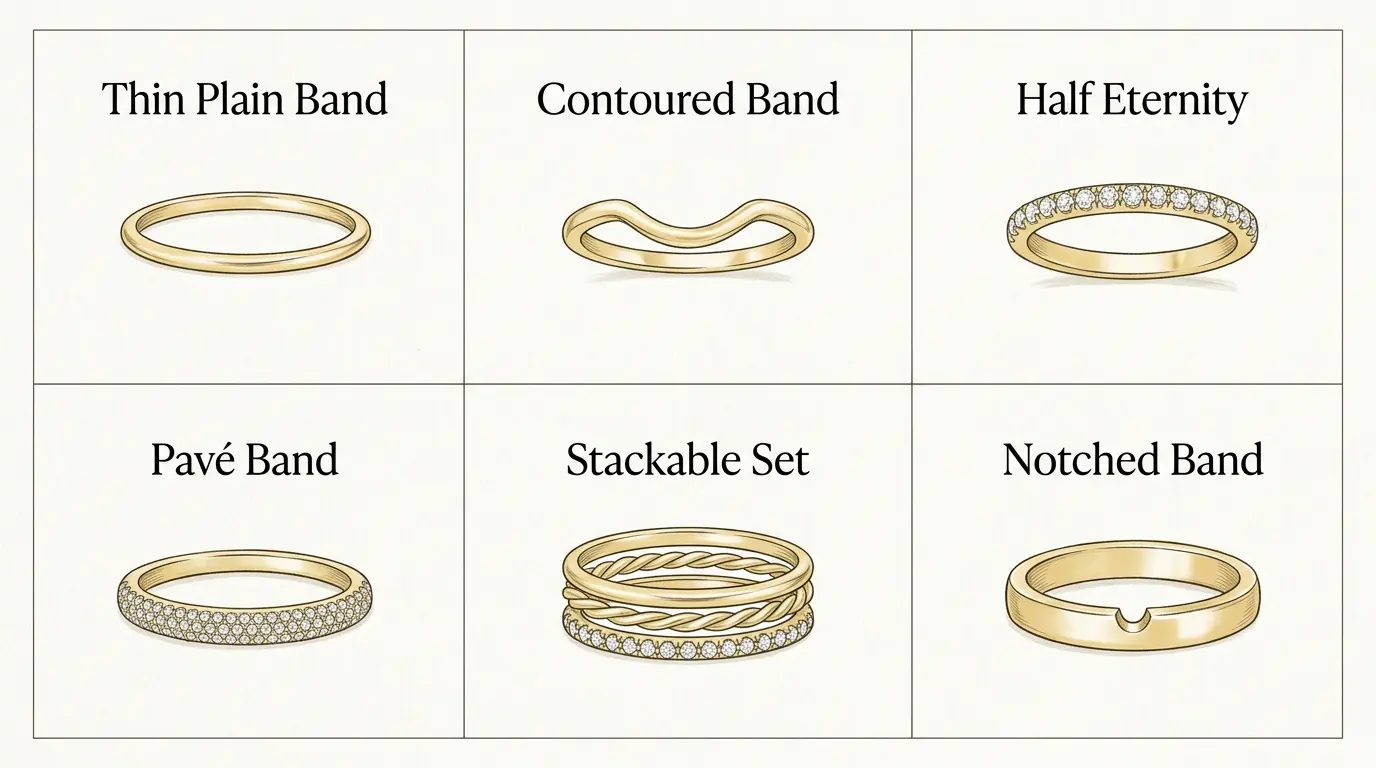
Style is what most people notice first. Here are the most common designs, what makes each one different, and who tends to love them.
Classic Plain Band
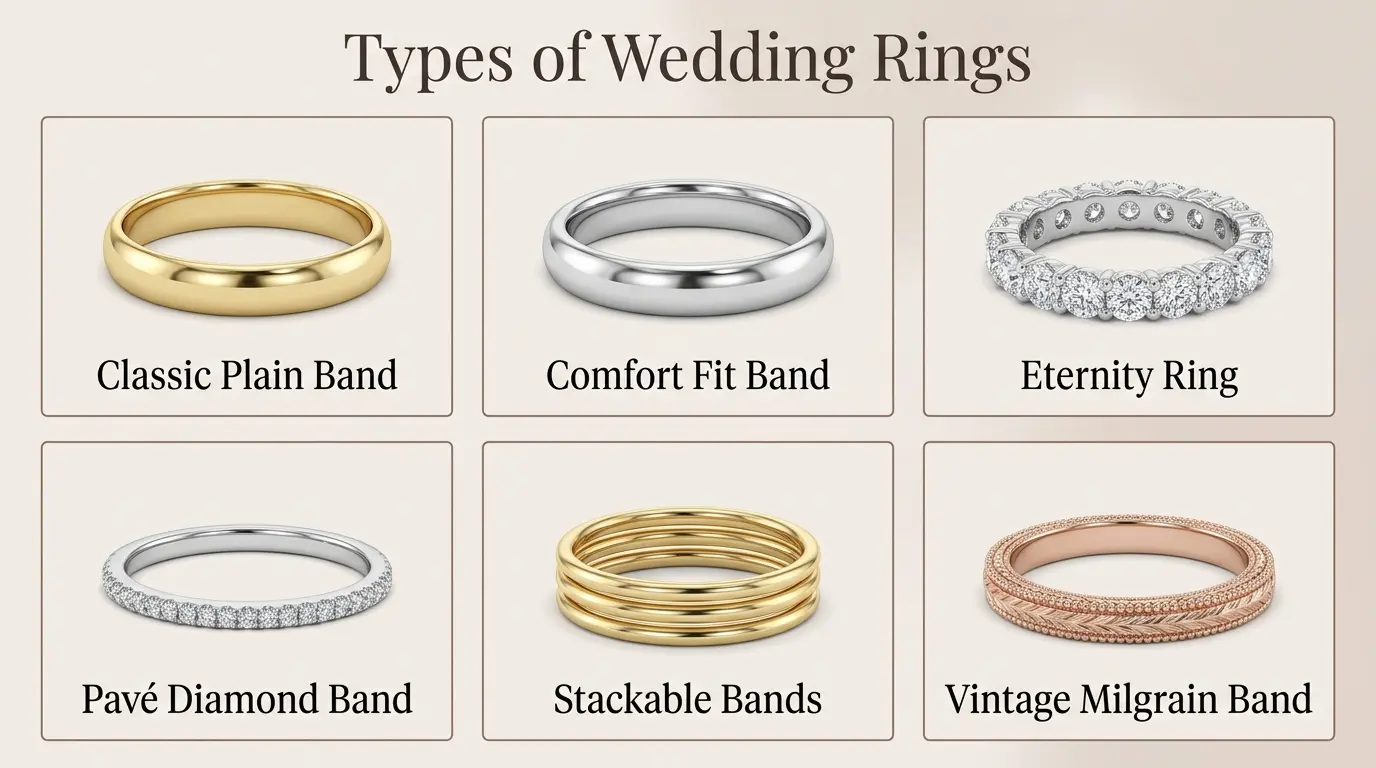
A classic plain band is a smooth, polished ring with no stones and no pattern. It is the traditional choice and the easiest to wear, match, and maintain.
Best for: Anyone who wants a timeless look, a low-maintenance ring, or a band that pairs with almost any engagement ring.
Comfort Fit Band
A comfort fit band has a slightly rounded inner surface, so it slides over the knuckle more easily and feels smoother against the skin. It looks the same as a standard band from the outside.
Best for: Daily wear, wider bands, and anyone whose fingers swell during the day.
Eternity Rings (Full and Half)
An eternity ring is set with a continuous line of diamonds or gemstones. In a full eternity ring, the stones circle the entire band. In a half eternity ring, they cover only the top portion.
Full eternity rings sparkle from every angle but are harder to resize. Half eternity rings are more comfortable and far easier to adjust later.
Best for: Couples who want a symbol of endless commitment and a little extra sparkle.
Diamond and Gemstone Bands
These bands add stones for brilliance while staying wearable. The setting style changes both the look and the durability:
- Pavé: Tiny stones set close together, held by small beads of metal, creating a "paved" surface of sparkle.
- Channel: Stones sit in a groove between two metal walls, protected from snags.
- Bezel: Each stone is wrapped in a thin metal rim for a sleek, secure finish.
- Flush-set (burnish-set): Stones are sunk into the metal so the surface stays smooth.
- Shared prong: Small prongs hold neighboring stones, letting more light in.
Best for: Those who want sparkle. Channel and flush settings are the best choice for active hands.
Contoured and Curved Bands
A contoured band has a gentle curve or notch that lets it sit flush against an engagement ring. It removes the awkward gap that often appears next to pear, oval, marquise, or halo center stones.
Best for: Anyone wearing a shaped or high-set engagement ring.
Stackable Bands
Stackable bands are slim rings designed to be layered. You can start with one and add more for anniversaries, births, or milestones, so your ring stack grows with your story.
Best for: People who love personalization and do not mind a slightly more styled look.
Vintage and Antique-Style Bands
Vintage-inspired bands borrow details from Victorian, Edwardian, and Art Deco jewelry. Look for milgrain (tiny beaded edging), filigree (lacy metalwork), and hand engraving.
Best for: Romantics who want a ring with character and a sense of history.
Textured, Hammered, and Matte Bands
Not every ring needs a mirror polish. Hammered finishes catch light in soft, uneven ways. Brushed and matte finishes give a modern, understated look and hide everyday scratches better than high polish.
Best for: Practical wearers who prefer a low-shine, modern feel.
Two-Tone and Tri-Tone Bands
These rings combine metals such as yellow, white, and rose gold in one design. They are useful if you wear mixed jewelry or want a ring that works with both your watch and your necklace.
Best for: People who like variety or cannot decide on one metal color.
Braided and Twisted Bands
Two or more strands of metal are woven into one ring. The look is often read as a symbol of two lives joined together, which is why couples choose it for its meaning as much as its style.
Best for: Couples who want a design with a story behind it.
Open and Cigar Bands
An open band leaves a small gap in the design for an airy, artistic feel. A cigar band is a wide, smooth ring that wraps the finger like a sculpted ribbon. Both are part of a wider shift toward bolder, more expressive wedding rings.
Best for: Those who want a statement ring with a contemporary edge.
Matching Sets and Bridal Sets
A matching set gives both partners rings from the same design family. A bridal set pairs an engagement ring with a wedding band made to fit together. Matching does not have to mean identical. Many couples choose the same metal and finish in different widths.
Best for: Couples who like a coordinated look without wearing carbon copies.
Types of Wedding Rings by Metal
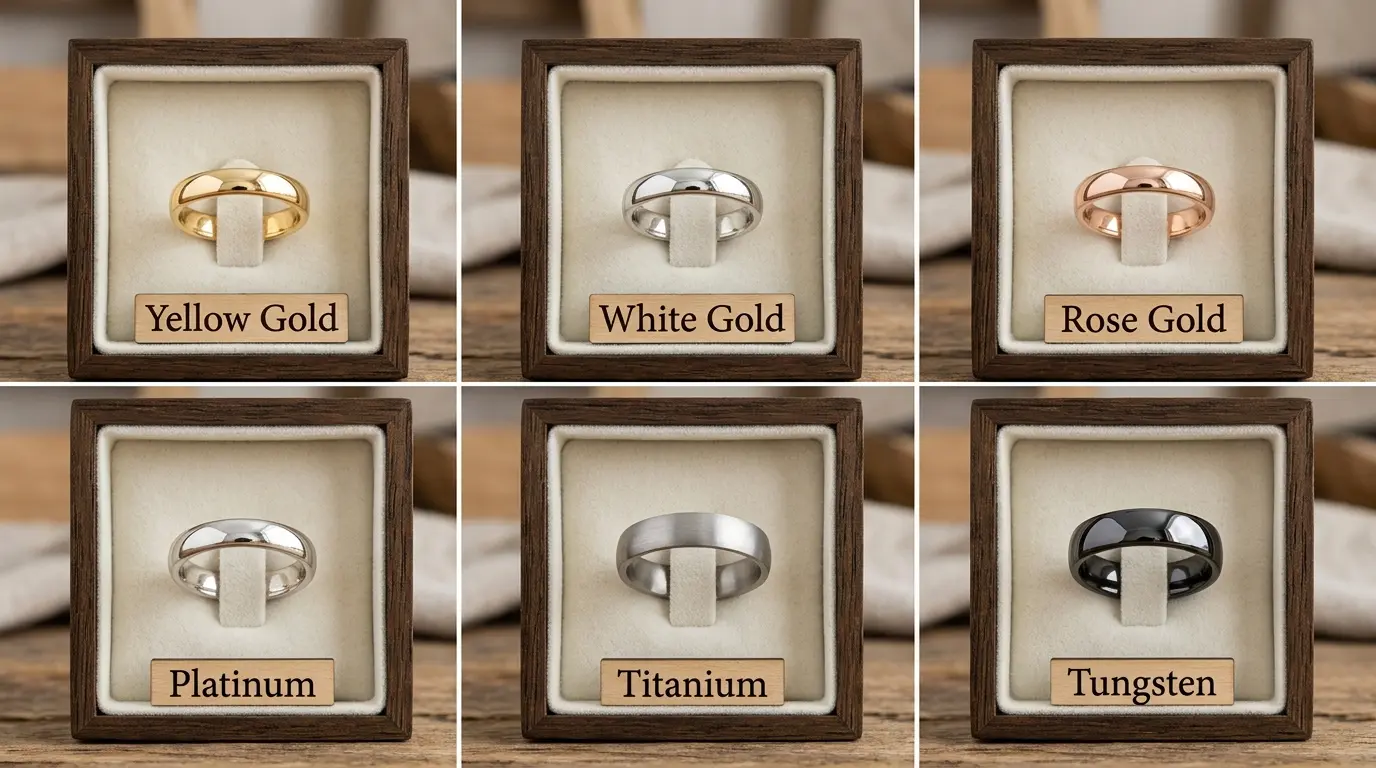
The metal decides how your ring feels, ages, and costs. It also matters for skin sensitivity.
Gold (Yellow, White, and Rose)
Gold is the classic choice. Pure gold is 24K, which is too soft for daily wear, so it is mixed with other metals to make it stronger.
- 18K gold is about 75% gold. It has a richer color but is a little softer.
- 14K gold is about 58% gold. It offers a strong balance of durability and price, which is why it is so popular.
- 10K gold is about 42% gold. It is the toughest and cheapest, with a paler color.
Yellow gold looks warm and traditional. White gold is usually coated with rhodium for a bright, silvery finish, and that coating may need refreshing every few years. Rose gold gets its pink tone from copper and tends to be very durable.
Platinum
Platinum is dense, naturally white, and known for being hypoallergenic. It does not fade or need plating. When scratched, the metal shifts rather than wearing away, developing a soft, matte patina over time. It costs more than gold, mostly because of its purity and weight.
Palladium and Silver
Palladium belongs to the platinum family. It looks similar, is lighter in weight, and usually costs less. Sterling silver is affordable but soft and prone to tarnish, so it is better for occasional rings than lifelong wear.
Titanium, Tungsten, and Stainless Steel
These modern metals are popular for men's bands and for anyone who wants a tough, low-cost ring.
- Titanium: Very light, strong, and hypoallergenic.
- Tungsten carbide: Extremely scratch resistant, though brittle enough to crack under a hard, sharp impact.
- Stainless steel: Affordable and tough, with a modern gray tone.
Keep in mind that these metals generally cannot be resized, so getting the size right the first time matters.
Alternative Materials
Ceramic, wood, carbon fiber, and silicone rings are gaining ground. Silicone bands in particular have become a smart backup for gym sessions, hiking, or manual work, where you may not want to risk your precious ring.
Wedding Ring Metals at a Glance
| Metal | Durability | Price Level | Maintenance | Best For |
|---|---|---|---|---|
| 14K Gold | High | Medium | Low | Everyday wear, balanced budget |
| 18K Gold | Medium to High | Medium to High | Low to Medium | Rich color, gentler wear |
| Platinum | Very High | High | Low | Sensitive skin, heirloom rings |
| Palladium | High | Medium | Low | Platinum look on a smaller budget |
| Titanium | Very High | Low | Very Low | Active lifestyles, light weight |
| Tungsten | Very High (scratch) | Low | Very Low | Scratch resistance, bold looks |
| Sterling Silver | Low | Low | High | Short-term or occasional wear |
Wedding Ring Profiles and Widths
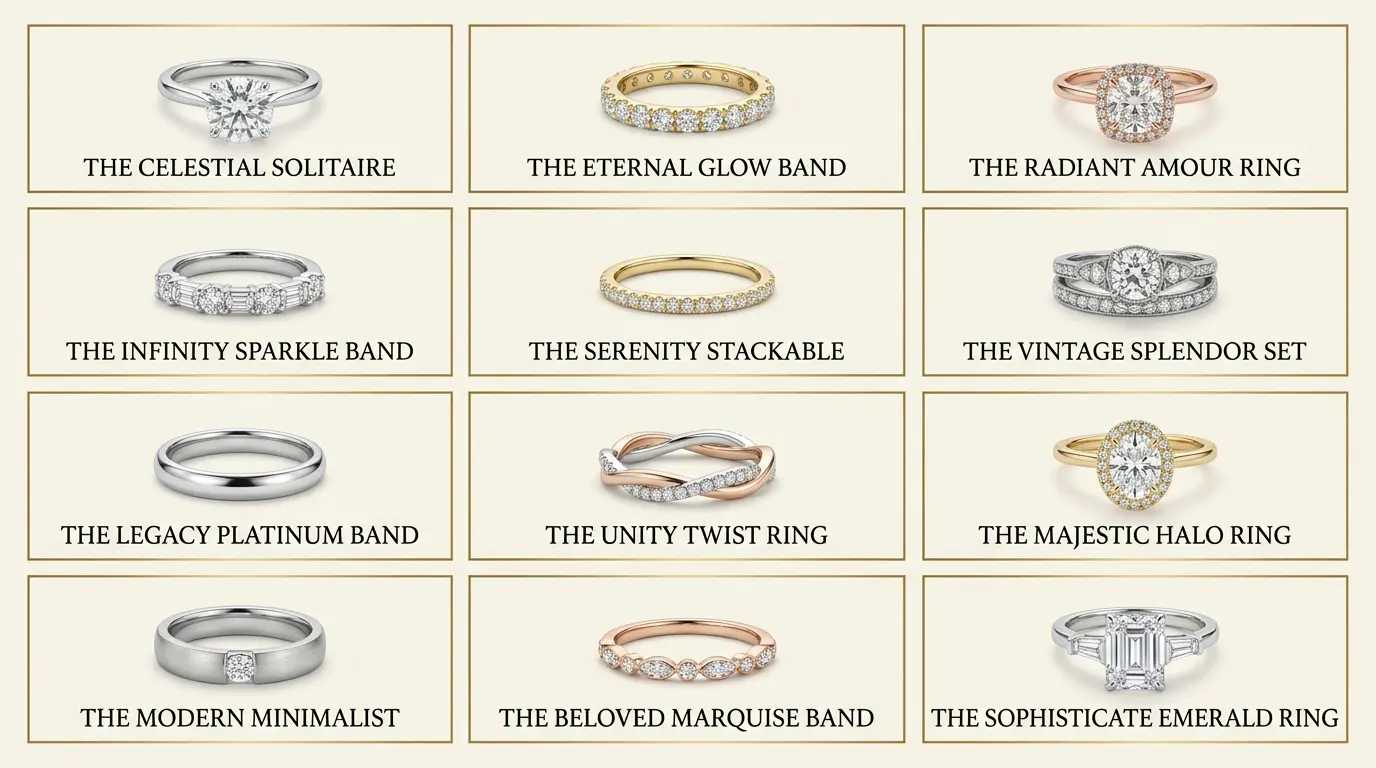
Two rings in the same metal can feel completely different because of their profile (the shape of the band) and width.
Common Profiles
- Flat: Flat on the outside and inside. Modern, architectural, and popular for men's bands.
- Domed (D-shape or half-round): Rounded outside, flatter inside. A traditional, familiar look.
- Court (comfort fit): Rounded both outside and inside for the smoothest feel.
How to Choose the Right Width
As a general guide:
- 1.5mm to 2.5mm: Delicate and minimal, ideal for stacking.
- 3mm to 4mm: The most common range for women's bands.
- 5mm to 6mm: A popular range for many men's rings and bolder women's styles.
- 7mm to 8mm and above: Statement bands that suit larger hands or a bold taste.
Wider bands often feel tighter, so many jewelers suggest going up a half size when choosing a broad ring.
Types of Wedding Rings for Women
Women's wedding rings tend to focus on how well the band works with an engagement ring. The most popular options include:
- Thin, delicate plain bands for a light, minimal look
- Contoured or notched bands that nest around the center stone
- Half or full eternity bands for extra brilliance
- Pavé bands that echo the engagement ring's sparkle
- Stackable bands built into a growing ring stack
If your engagement ring has a high setting or an unusual shape, try the band on with it before buying. A ring that looks perfect alone can leave an awkward gap once the two are side by side.
Types of Wedding Rings for Men
Men's wedding rings have moved far beyond the plain gold band. Popular choices include:
- Classic flat or domed bands in gold, platinum, or palladium
- Brushed or matte bands that resist showing scratches
- Beveled or step-edge bands with a crisp, architectural outline
- Titanium and tungsten bands for strength and low cost
- Inlay designs with carbon fiber, wood, or meteorite for a distinctive look
- Diamond-accented bands with a single stone or a subtle row of small ones
Think about work and hobbies. If you use your hands a lot, choose a comfort fit profile in a durable metal, and remember that some men prefer platinum, palladium, titanium, or silver-toned metals, including for religious or cultural reasons where gold is avoided for men.
Traditional and Cultural Wedding Rings
Wedding rings carry different meanings around the world. A few well-known designs:
- Claddagh ring: An Irish design showing two hands holding a crowned heart. Which way the heart faces can signal relationship status.
- Gimmel ring: Two or three interlocking bands that are worn separately before the wedding and joined during the ceremony.
- Posy ring: A band with a short message engraved inside.
- Russian wedding ring: Three interlinked bands in different gold colors, often representing faith, hope, and love.
- Fede ring: An old Italian design featuring two clasped hands.
Even which hand you wear your ring on depends on where you live. Many countries use the left ring finger, while others such as Germany, Poland, and Russia commonly use the right hand.
How to Choose the Right Type of Wedding Ring
Match Your Lifestyle and Profession
Think about what your hands do all day. If you lift weights, garden, cook, or work with tools, a flush-set or plain comfort fit band in a tough metal will last longer than a high-set diamond ring with tall prongs.
Consider Skin Sensitivity and Metal Allergies
Some alloys, including certain white golds, contain nickel and can irritate sensitive skin. Platinum, palladium, titanium, and nickel-free gold are safer options. If your skin reacts to jewelry, mention it to your jeweler before you buy.
Set a Realistic Budget
Prices change a lot by region, brand, weight, and diamond quality. Treat these as rough starting points, not quotes:
| Ring Type | Approximate Range (USD) |
|---|---|
| Plain 14K gold band | $250 to $900 |
| Plain platinum band | $600 to $2,000 |
| Titanium, tungsten, or steel band | $30 to $300 |
| Diamond pavé or channel band | $700 to $3,500 |
| Full diamond eternity band | $1,000 to $8,000 or more |
Lab-grown diamonds often lower the price of diamond bands noticeably, which lets some couples choose a fuller design within the same budget.
Coordinate With the Engagement Ring
Matching metals is usually the safest route. If you wear a mix, keep at least one detail in common, such as the finish, the width, or a milgrain edge. Bring the engagement ring with you when you shop.
Get the Sizing Right
Fingers swell in heat and shrink in the cold, so measure later in the day and avoid sizing when your hands are chilled. Try the ring on for a few minutes and check that it slides over your knuckle with slight resistance but still turns freely.
Wedding Ring Trends in 2026
Wedding bands are getting as much attention as the engagement ring they sit beside. These are the directions couples and designers are leaning toward this year:
- Bolder, wider gold bands: Slim, barely-there rings are being joined by thicker, more substantial bands with a confident presence.
- Sculptural and organic shapes: Curved, wavy, and asymmetrical designs that feel like wearable art.
- Bezel and flush-set diamonds: Smooth, snag-free settings with a clean, graphic look.
- Statement diamond bands: Mixing shapes like baguette, emerald, and marquise for more interesting rhythm than a simple row of rounds.
- Stackable ring sets: Building a personal look over time rather than buying one final band.
- Mixed metals: Combining yellow, white, and rose gold in a single ring or stack.
- Textured and matte finishes: A calmer, tactile alternative to high polish.
- Personal and sustainable choices: Custom engravings, recycled metals, lab-grown stones, and redesigned family heirlooms.
Trends are fun, but a wedding ring is worn for decades. If a trend excites you, choose it because you love it, not because it is popular this year.
How to Care for Your Wedding Ring
A little regular care keeps your ring looking new:
- Clean it gently: Soak in warm water with mild soap, brush softly with a baby toothbrush, and rinse well.
- Avoid harsh chemicals: Chlorine, bleach, and strong cleaners can damage gold and loosen stones.
- Take it off for rough tasks: Remove it for the gym, heavy lifting, gardening, and cleaning.
- Store it safely: Keep it in a soft pouch or ring box, away from other jewelry that could scratch it.
- Get it checked once a year: A jeweler can spot loose prongs and worn settings before a stone is lost.
- Refresh when needed: White gold may need re-plating, and most polished bands can be professionally buffed.
Frequently Asked Questions
What are the different types of wedding rings?
The most common types are classic plain bands, comfort fit bands, diamond-set bands, eternity rings, contoured bands, stackable rings, vintage-inspired bands, textured bands, and two-tone bands. They can be made in gold, platinum, palladium, titanium, tungsten, and other metals.
What is the most popular type of wedding ring?
Classic plain bands and diamond-set bands remain the most popular choices worldwide. Comfort fit profiles are also very common because they are easy to wear every day. Stackable rings and bolder gold bands are growing quickly as more couples look for personal, expressive designs.
What is the difference between a wedding ring and a wedding band?
There is very little difference. "Wedding band" usually refers to a simple, ring-shaped band, while "wedding ring" is a broader term that can include stone-set or decorative designs. Most jewelers and buyers use both terms to mean the ring exchanged during the ceremony.
Which metal is best for a wedding ring?
It depends on your budget and lifestyle. Platinum is the most durable and hypoallergenic premium choice. 14K gold offers the best balance of strength, look, and price. Titanium and tungsten are excellent low-cost options for people who want a tough, low-maintenance ring.
What is the most durable wedding ring material?
Tungsten carbide is the most scratch resistant, though it can crack under a sharp impact. Platinum and titanium are both highly durable overall. For a classic look, 14K gold and platinum offer the best mix of strength and long-term wearability.
Which finger is the wedding ring worn on?
In many countries, including the United States, the United Kingdom, and India, the wedding ring is worn on the left ring finger. In others, such as Germany, Poland, and Russia, it is commonly worn on the right hand. Traditions vary, so wear it in the way that feels right for you.
Final Thoughts
There is no single best type of wedding ring, only the one that fits your life. Start with how you live, then choose a metal that suits your skin and budget, and finish with the style that feels like you.
Try rings on in person if you can, compare them with your engagement ring, and give yourself time. A wedding ring is one of the few pieces you will wear every day for years, so it deserves a decision made with a clear head and a happy heart.
Alliance Editorial Team
Our in-house team of wedding writers and editors.