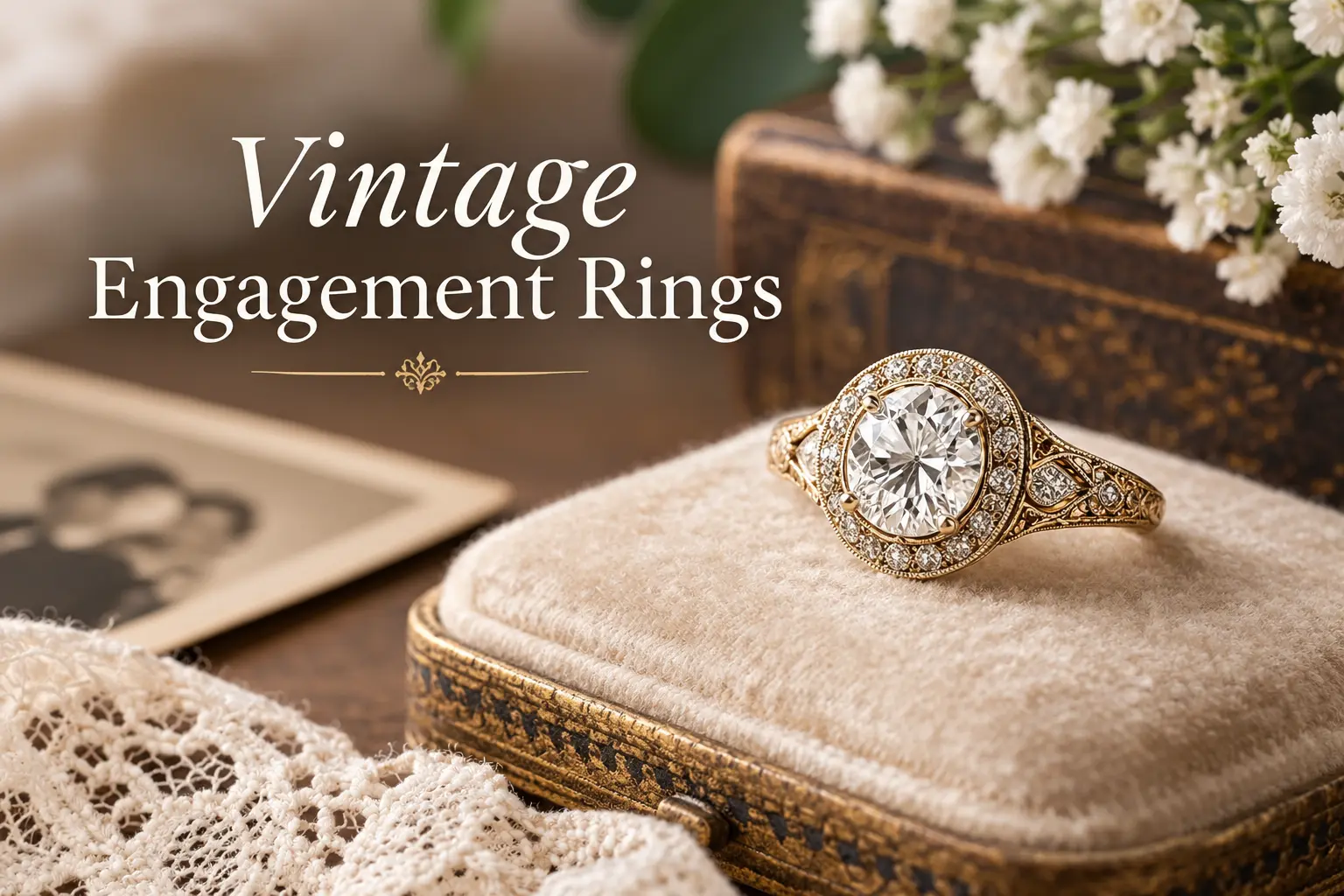
A vintage engagement ring is a genuine ring that is at least 20 years old, or a new ring made in the style of an earlier era. The main styles are Victorian (1837-1901), Edwardian (1901-1915), Art Deco (1920-1935) and Retro (1935-1950). If you want history and a one of a kind piece, buy authentic vintage. If you want the look with modern durability and easy resizing, choose a vintage inspired engagement ring.
Some rings just feel like they have a story. A vintage engagement ring has that quality. The metalwork is more detailed, the stones are cut by hand, and the design has a personality that most modern settings do not.
This guide walks you through the eras, the details that define each one, and the practical things to check before you buy.
What Makes an Engagement Ring Vintage?
The words vintage, antique and vintage inspired get mixed up all the time, so here is the simple version.
- Antique rings are 100 years old or more.
- Vintage rings are roughly 20 to 99 years old.
- Vintage inspired rings are brand new but designed to echo an older era.
The difference matters for price, condition and how much wear you can expect. It also matters when you are searching, because a shop selling "vintage style engagement rings" may be selling new pieces, not old ones.
Vintage vs Vintage Inspired Engagement Rings
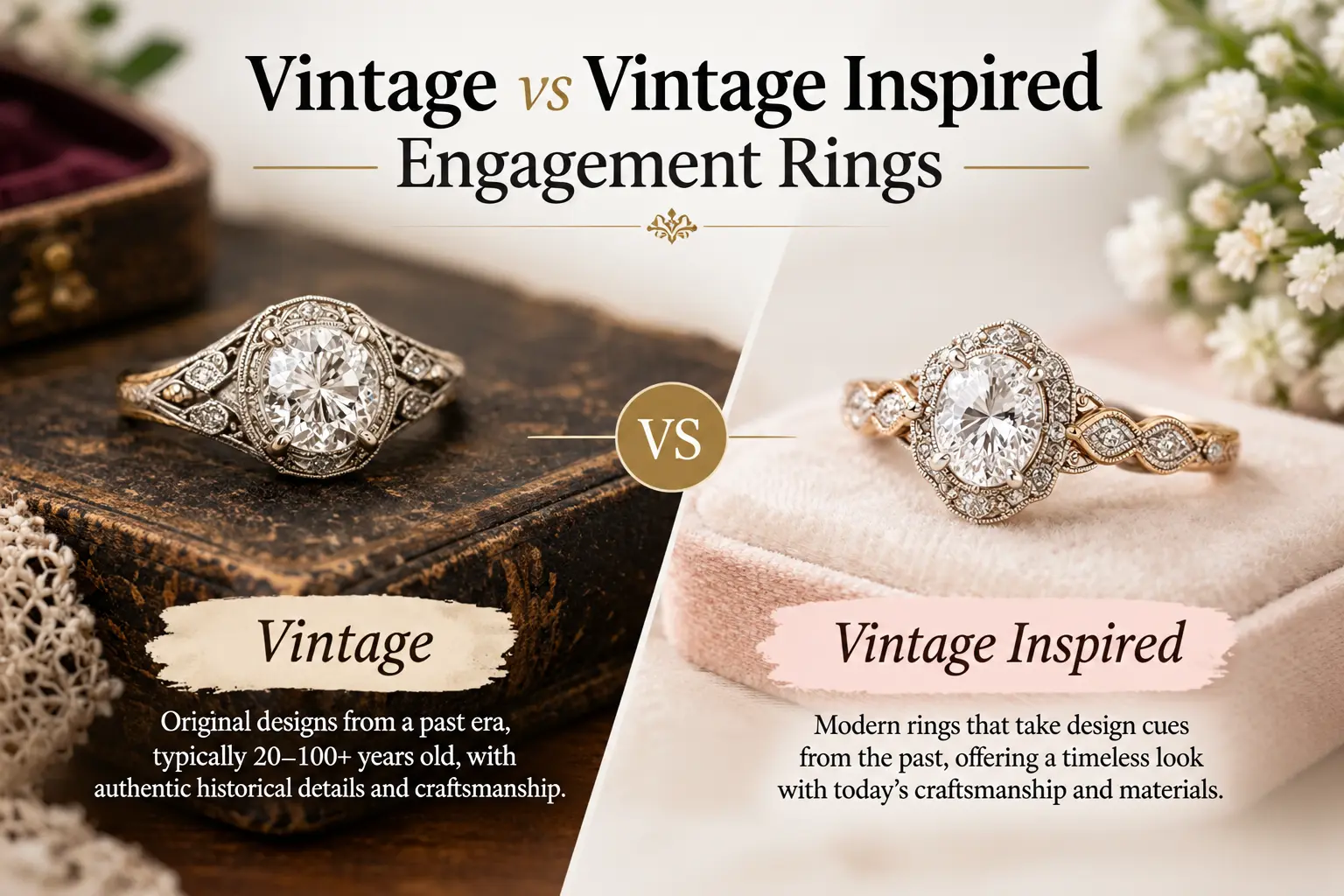
Neither option is better. It depends on what you value.
Authentic vintage gives you real history and hand finished detail. No one else will have the same ring. The trade offs are that stones may be worn, settings may be thin, and some rings are hard to resize.
Vintage inspired gives you the design without the guesswork. The metal is fresh, the prongs are strong, and you can usually choose your own stone, metal and size. It is a sensible choice if the ring will be worn every day for decades.
Vintage Style Engagement Rings by Era
Knowing the era helps you understand what you are looking at and what a fair price looks like.
Victorian Engagement Rings (1837-1901)
Victorian rings are romantic and full of symbolism. Think hearts, flowers, snakes (a symbol of eternal love) and clusters of stones around a center gem. Yellow gold and rose gold were common, and colored stones like garnets, sapphires and rubies sat beside diamonds. Diamonds from this time are usually old mine cuts, with a soft, warm glow.
Choose this era if you love sentimental details and warm metals.
Edwardian Engagement Rings (1901-1915)
Once platinum became widely used in jewelry, makers could create fine, lace like metalwork. Edwardian rings are light and airy, with filigree, milgrain edges and small accent diamonds. Center stones are usually old European cuts.
Choose this era if you like delicate, elegant and slightly formal designs.
Art Deco Engagement Rings (1920-1935)
Art Deco broke away from soft curves. Designs became geometric, symmetrical and bold. You will see step cuts like emerald and baguette, calibre cut sapphires along the sides, and sharp architectural lines, mostly in platinum and white gold.
Choose this era if you want something striking and clean at the same time.
Retro Engagement Rings (1935-1950)
Retro rings are bigger and bolder. Rose gold and yellow gold came back, with swirls, ribbons and raised, sculptural shapes. They feel warm and confident.
Choose this era if you want a statement ring with a lot of presence.
Vintage Engagement Ring Settings and Diamond Cuts to Know
Two things shape how a vintage ring looks more than anything else: the setting and the cut.
Common Settings
- Filigree: open, lace like metalwork.
- Milgrain: tiny beads along the edge of the metal.
- Halo and cluster: small stones surrounding a center stone.
- Bezel: metal wrapped around the stone for extra protection.
- East-west: an oval or marquise stone set sideways.
Common Cuts
- Old mine cut: cushion shaped with a high crown and a large flat bottom. It sparkles softly, not sharply.
- Old European cut: round, with a small table and larger facets. It gives a chunky, candlelit flash.
- Rose cut: flat on the bottom and domed on top. It has a gentle glow.
- Step cuts: emerald and baguette shapes with long, clean facets.
Old cuts do not sparkle like modern brilliant cuts. That is part of their charm, but it helps to see the stone in person or on video before you commit.
How to Tell If a Ring Is Really Vintage
Look for these signs, and always ask for documentation.
- Hallmarks and stamps. Metal purity marks or maker marks can help date a ring.
- Stone cut. A modern round brilliant in a supposedly 1920s ring is a warning sign.
- Construction. Older rings often show hand finishing, slight asymmetry and soft wear on the edges.
- Metal. Platinum was rare before the 1900s, so a "Victorian" ring in platinum deserves questions.
- Paperwork. Ask for a gemological report, an appraisal or a written description from the seller.
If you are spending serious money, have an independent appraiser or gemologist check it.
What to Check Before You Buy
Vintage rings are beautiful, but they need a careful eye.
- Prongs and shank: thin or worn metal may need retipping or reinforcing.
- Resizing: engraved bands, channel set stones and delicate filigree can limit how much a ring can be adjusted.
- Stone condition: look for chips, cracks and loose stones.
- Repairs: ask what has been replaced or restored, and whether it is disclosed.
- Return policy: a fair seller should give you time to have the ring inspected.
- Insurance: get an appraisal and insure the ring, as replacement is often impossible.
Vintage Style Wedding Rings and Matching Bands
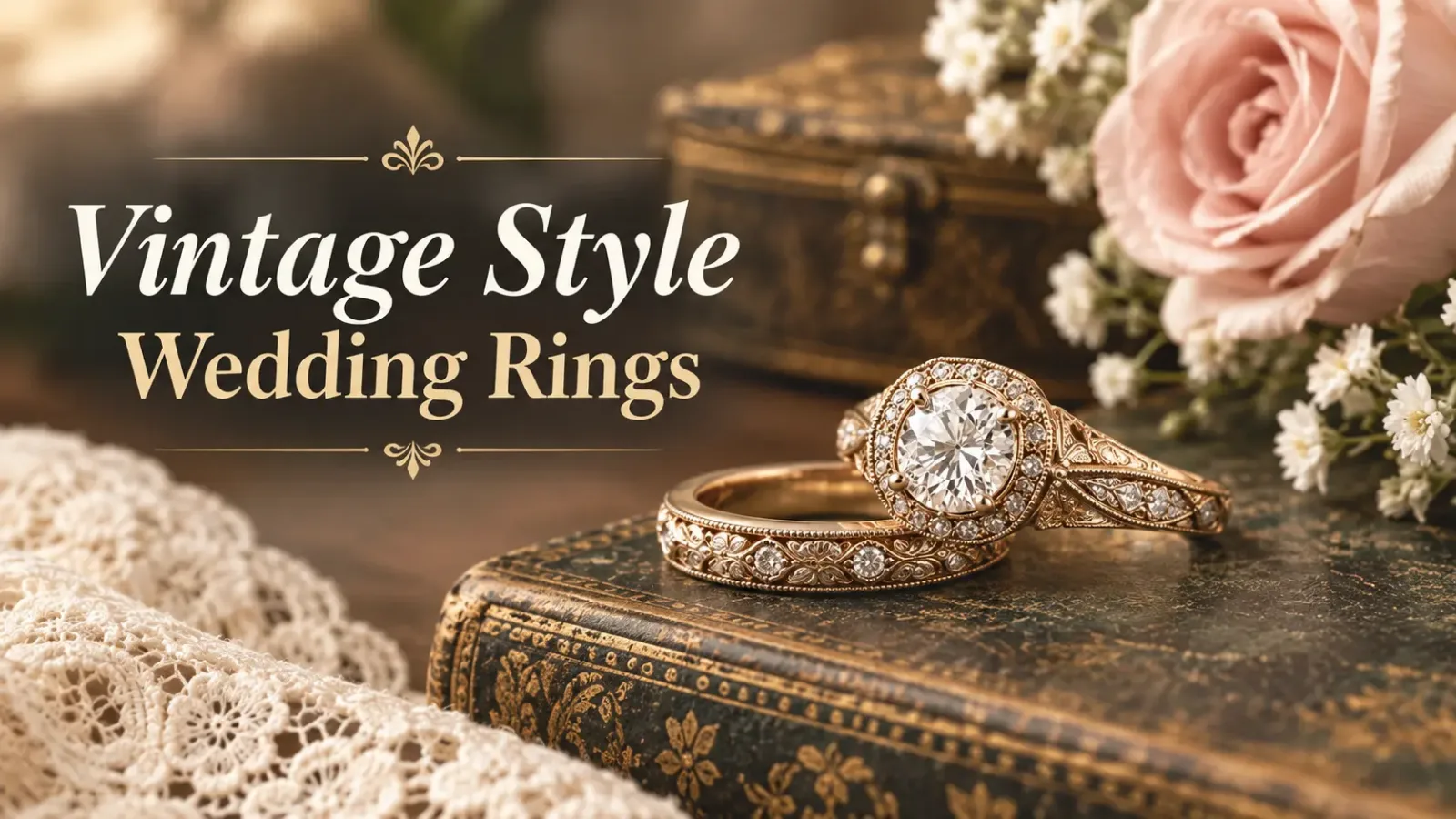
Pairing is easier than people expect. Many vintage style wedding rings are made to sit close to an engagement ring, with matching milgrain edges or simple curved shapes that fit around a halo. If your engagement ring has a low profile setting, a straight band works well. If it has a wide cluster, a contoured or notched band avoids gaps.
Try the two rings together before buying. Vintage settings vary a lot, and a band that looks perfect alone can sit awkwardly next to an antique shape.
Caring for a Vintage Engagement Ring
- Clean it gently with warm water, mild soap and a soft brush.
- Avoid ultrasonic cleaners on fragile or old stones unless a jeweler approves.
- Remove the ring for heavy lifting, workouts and cleaning.
- Have prongs checked by a jeweler every six to twelve months.
- Store it separately so harder stones do not scratch softer metal.
Which Vintage Style Is Right for You?
| If you love | Consider |
|---|---|
| Romance and symbolism | Victorian |
| Delicate lace like detail | Edwardian |
| Bold geometry | Art Deco |
| Big, sculptural shapes | Retro |
| The look, with easy resizing | Vintage inspired |
Frequently Asked Questions
What is the difference between vintage and antique engagement rings?
Antique rings are 100 years old or more. Vintage rings are at least 20 years old, and generally under 100.
Are vintage engagement rings more expensive?
It varies. Art Deco and Edwardian pieces in good condition tend to be priced higher, while some Victorian and Retro rings offer strong value. Condition, stone quality and metal all affect the price.
Can you resize a vintage engagement ring?
Often yes, but not always. Detailed bands, channel settings and thin filigree can limit changes, so ask a jeweler before you buy.
Are vintage inspired engagement rings as good as real vintage?
They are different. You give up the history, but you gain stronger metal, easier resizing and more choice over the stone.
Which vintage era is best for an engagement ring?
There is no single best era. Edwardian and Art Deco are the most popular, but the right choice is the one that suits your taste and daily life.
Do vintage engagement rings hold their value?
Well made, well kept rings from desirable eras often hold value better than mass produced modern pieces. Keep your paperwork and get regular appraisals.
Final Thoughts
A vintage engagement ring is a choice about character. Whether you go for a hundred year old Edwardian ring or a new piece inspired by Art Deco, focus on the details that matter: the era, the cut, the condition and the seller's honesty. Take your time, ask questions, and choose the ring that feels like it belongs to your story.
Alliance Editorial Team
Our in-house team of wedding writers and editors.